Build, Borrow, or Buy Talent: How to Fill a Leadership Gap

Build, borrow, or buy talent is a leadership strategy for deciding whether to develop someone internally, hire a permanent leader from the outside, or bring in fractional or interim leadership to close a gap.
For founder-led companies, this is not an HR exercise.
It is an operating decision.
When a leadership seat is empty or underdeveloped, the business feels it quickly. Priorities stall. Decisions come back to the founder. Department leaders work hard but stay in their own lanes. The team has activity, but not enough execution.
That is usually when the founder starts asking:
Do I develop someone already here?
Do I hire a full-time COO or Integrator?
Do I bring in a fractional leader to stabilize the business now?
There is no universal answer.
The right move depends on the seat, the urgency, the internal bench, the complexity of the business, and how much risk the company can tolerate while the gap remains open.
What “Build, Borrow, or Buy Talent” Actually Means
The build, borrow, or buy talent strategy helps companies choose the best way to fill a capability gap.
Build means developing someone already inside the business.
Buy means hiring a permanent leader from the outside.
Borrow means using external expertise for a defined need, such as a consultant, advisor, interim leader, or fractional executive.
Some companies also talk about “rent” as a fourth option. In practice, rent usually means embedded fractional or interim leadership that owns outcomes for a longer period than a project-based consultant.
There is also a newer “bot” category, meaning AI or automation. AI can support workflows, reporting, documentation, and analysis. But it should not replace real leadership. A leadership gap requires judgment, accountability, decision-making, and trust. AI cannot own that seat.
For founder-led companies, the most important question is not which category sounds best.
The question is: what does the business need this seat to do right now?
Build: Develop the Leader You Already Have
Building from within can be the right call when you have a capable internal leader with the wiring, credibility, and desire to grow into the seat.
This is often attractive because the person already knows the business. They understand the customers, culture, team dynamics, history, and founder’s expectations. They may already have trust across the organization.
That matters.
An internal leader does not need six months to learn the language of the company.
When Building Is the Right Call
Build when the business has time, the internal candidate has real leadership potential, and the role can be developed without putting execution at risk.
This works best when the person already demonstrates ownership. They do not wait to be pushed. They solve issues. They can handle conflict. They think beyond their department. They are respected, not just liked.
Building is also the right call when preserving culture is critical and the leadership gap is not creating immediate drag.
Where Building Breaks Down
Building breaks down when the founder promotes someone because they are loyal, available, or familiar, not because they are ready.
That is common.
A strong manager is not automatically an Integrator. A high performer is not automatically a company-level leader. A trusted employee may still struggle to hold peers accountable.
The risk is time.
If the person needs 12 to 18 months to grow into the seat, what happens while the business waits?
Do priorities keep slipping?Does the founder stay buried in operations?Do leaders keep avoiding hard decisions?
That is why the build path needs structure, coaching, and clear checkpoints. For a deeper comparison, see GCE’s guide on hiring vs training a fractional Integrator.
Buy: Hire a Permanent Leader From the Outside
Buying talent means recruiting a full-time leader who brings the experience the business does not currently have.
This may be the right move when the company has a long-term leadership need, the budget to support the role, and clarity around what the seat must own.
For example, a business may need a full-time COO, CFO, VP of Sales, Head of People, or Integrator because the complexity has outgrown the current structure.
When Buying Is the Right Call
Buy when the role is permanent, the need is clear, and the business is ready to support a senior leader.
That means the company knows what success looks like. Decision rights are defined. The founder is ready to give the person real authority. The leadership team understands the seat.
This is especially important when hiring a COO. A title does not make someone second-in-command. The seat needs authority, clarity, and trust.
Where Buying Breaks Down
Buying breaks down when the company hires before it understands the seat.
That creates expensive confusion.
The new leader walks into unclear expectations, founder bottlenecks, vague authority, and a leadership team that does not know how to work with them.
The founder thinks they hired leverage.
The leader inherits chaos.
Buying also takes time. Recruiting, evaluating, hiring, and onboarding a senior leader can stretch for months. If the business needs execution discipline now, waiting for a permanent hire may not be enough.

Borrow and Rent: Bring in Fractional or Interim Leadership
Borrowing or renting talent means bringing in outside leadership without committing to a permanent full-time hire.
This can include consultants, advisors, interim executives, fractional COOs, fractional CFOs, sales leaders, HR leaders, or fractional Integrators.
The distinction matters.
A consultant may advise on a problem.
An interim leader may fill a seat temporarily.
A fractional leader may embed into the business over time and own outcomes.
For founder-led companies, a fractional Integrator often fits the “rent” category better than basic borrowing. They are not just giving advice. They are stepping into the operating rhythm, helping lead execution, building cadence, and strengthening accountability.
When Borrowing or Renting Is the Right Call
Borrow or rent when the business needs experienced leadership now, but the long-term answer is not fully clear.
This works well when:
The founder is still the bottleneck.
The leadership team needs stronger accountability.
The company is not ready for a full-time executive.
An internal leader may be developed but needs coaching.
The business needs traction while it pressure-tests the seat.
Fractional leadership gives the company flexibility. You can bring in senior operating capability without overbuilding the payroll too early.
For companies evaluating options, GCE’s guide on where to hire fractionals can help frame the search.
Where Borrowing or Renting Breaks Down
Fractional leadership breaks down when the role is treated like a vendor relationship.
If the external leader is not integrated into the leadership cadence, does not have clear outcomes, and lacks access to the right information, their impact will be limited.
Borrowed leadership still needs authority.
Otherwise, the founder keeps the weight and the fractional leader becomes another voice in the room.
How to Choose When You’re the Bottleneck
If the founder is the bottleneck, the decision should be based on urgency, readiness, and risk.
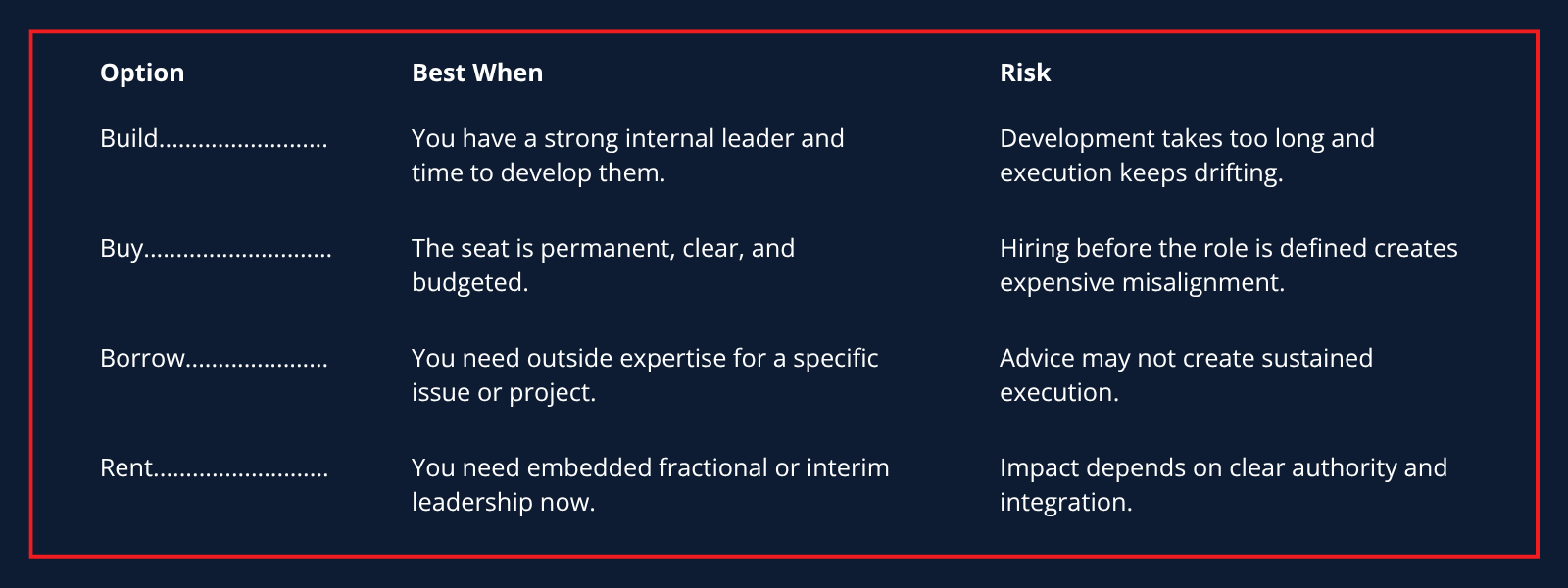
Here is the practical filter:
If the business can wait, build.
If the seat is clear and permanent, buy.
If the need is narrow, borrow.
If the business needs leadership now while the long-term answer is still forming, rent.
The founder has to be honest about the real constraint.
Is this a talent problem?
A structure problem?
A capacity problem?
An accountability problem?
A founder-dependency problem?
Different problems require different levers.
Your Next 90 Days: Pressure-Test the Seat and Pick a Lever
Do not make the build, borrow, or buy talent decision from frustration.
Pressure-test the seat first.
Over the next 90 days, define what the leadership gap is costing the business. Look at stalled priorities, repeated issues, decisions still sitting with the founder, missed numbers, unclear ownership, and leadership team friction.
Then define the seat.
What outcomes must this role own?
What decisions must this person make?
What authority does the seat need?
What would change if the role worked?
What would stay stuck if nothing changes?
Once that is clear, the lever becomes easier to choose.
Build the internal leader if they are ready and the business can support the development path.
Buy the permanent leader if the seat is clear and the company is ready for the hire.
Borrow specific expertise if the gap is narrow.
Rent fractional leadership if the business needs traction now and the founder needs an operator beside them.
This is the core idea behind The Integrator Edge: founder-led companies do not scale because the founder works harder. They scale when the right leadership structure turns vision into execution.
GCE’s Fractional Integrator Services help companies close that gap by bringing experienced operating leadership into the business while strengthening the team for the long term.
The goal is not to fill a title.
The goal is to build the leadership capacity the next stage requires.
FAQ
When should you build vs. buy vs. borrow talent?
Build when you have a capable internal leader and enough time to develop them. Buy when the role is permanent, clearly defined, and the company is ready for a full-time leader. Borrow when you need outside expertise for a specific problem. Rent fractional leadership when you need embedded execution support now.
What is the difference between borrowing and renting talent?
Borrowing usually means using outside expertise for a defined project or short-term need. Renting means bringing in fractional or interim leadership that operates inside the business, owns outcomes, and helps lead execution over a longer period.
Is a fractional Integrator a “borrow” or a “buy”?
A fractional Integrator is usually a rent or borrow option, depending on the engagement. They are not a permanent full-time hire, but they provide executive-level operating leadership and accountability inside the business.
What are the 4 B’s of talent management?
The common 4 B’s are build, buy, borrow, and bot. Build means developing internal talent. Buy means hiring externally. Borrow means using outside expertise. Bot refers to using AI or automation. For leadership gaps, AI can support the work, but it cannot replace judgment, accountability, or executive ownership.