Your leadership team agrees on a strategy to improve gross profit margin from 25% to 30%. At the next quarterly review, Sales is still offering discounts under the old pricing policy because nobody took responsibility for changing it. Finance continues to report the same margin shortfall, and you are back to chasing decisions your leadership team already agreed on.
In this article, we look at why strategy execution fails, how you can close the execution gap, and who should be accountable for turning business goals into measurable results.
What strategy execution means
Strategy execution is the process of putting a business plan into practice to achieve its intended results. It involves making department leaders accountable for specific outcomes and establishing a weekly process to review progress against targets. When decisions are delayed or departments miss commitments, someone must have the authority to resolve those issues and keep the work moving.
Strategy vs execution: where one ends and the other begins
Strategy determines how the business will achieve its goals, while execution puts those decisions into practice. Leaders then review results against their targets to see what's working and where they need to adjust the plan.
| Strategy | Execution | |
|---|---|---|
| Primary focus | Decide which opportunities to pursue and where the business should invest | Turn business decisions into departmental priorities with named owners |
| Time horizon | Typically one to three years or longer, with annual reviews | Quarterly priorities, weekly progress reviews, and daily operational decisions |
| Resource allocation | Decide how much to invest in hiring, technology, or expansion | Assign budgets and staff to specific initiatives, then address resource shortages |
| Ownership | The founder or CEO sets direction with the leadership team | Department heads own results, while the COO or Integrator coordinates execution across departments |
| Measurement | Set targets for revenue growth, gross profit margin, and customer retention | Track actual results against targets, supported by leading indicators such as pipeline value, average discounts, and renewal rates |
| Review and adjustment | Reassess investment priorities when business performance or market conditions change | Review weekly scorecards, resolve missed commitments, and adjust departmental work before quarterly deadlines |
| Example | Improve gross profit margin from 25% to 30% by changing discount policies and repricing low-margin contracts | Sales introduces approval limits for discounts, Finance reviews margins by account, and the operational leader ensures pricing changes are completed before contract renewals |
The execution gap: why most strategies stall after the planning
I've seen businesses spend days getting their strategy right, only to lose progress when everyone returns to their normal responsibilities. The real test comes after the planning session, when leaders have to deliver on what they agreed to.
Here are three reasons why this happens.
The plan has no owner below the founder
Founders often assume that once the leadership team agrees on a priority, everyone knows exactly what they need to deliver. The problem is the Tuesday after the planning session, when nobody below the founder knows what they own, what they can decide, or how anyone will find out if it slipped.
Let’s say your leadership team agrees to shorten customer onboarding time, but the sales team keeps handing over new accounts without confirming the services purchased or the agreed start date. The operations manager then has to chase the sales manager for those details before assigning staff and scheduling the work, delaying onboarding and leaving customers waiting longer than promised.
One leader needs to own the onboarding target and have the authority to change how both departments work together. Otherwise, the founder ends up resolving the same operational issues while the business continues missing its targets.
There are too many priorities and none are specific
When everything is a priority, leaders struggle to decide what deserves their attention first.
In The Integrator Edge, I share the example of a marketing agency that set 20 priorities every quarter. By the end of each quarter, about half were still unfinished, and the leadership team struggled to see what it had accomplished. We narrowed the focus by having each leader choose three priorities they could realistically deliver. With fewer competing commitments, the team had a clearer sense of what needed to get done and who was responsible for doing it.
The priorities also need to define what success looks like. "Improve client retention" leaves too much open to interpretation. "Increase the client renewal rate from 85% to 90% by the end of the quarter" gives the account management leader a measurable target.
Nobody sees the numbers weekly
Quarterly reviews are too late to catch problems that have been affecting the business for weeks. A weekly scorecard tracks metrics such as qualified sales opportunities, overdue invoices, and customer onboarding time, giving leaders a chance to address missed targets before they affect quarterly results. Our scorecard vs dashboard guide explains how to use both to monitor business performance. Every missed target needs an accountable owner and corrective action.
Why another tool will not close the gap
A scorecard sitting on a shared drive does not create accountability. Accountability is a design choice. Clear outcome, real authority, and a steady weekly rhythm.
A project management platform can show that a client implementation is two weeks behind schedule. It cannot decide whether to move employees from another project to finish the work or authorize additional resources. Those decisions require a leader with the authority to make them and take responsibility for the outcome.
The founder gets frustrated and goes looking for a better tool, a better template, a better framework. It is not the tool. Before investing in another platform, look at what happens when a deadline is missed. If every decision still requires the founder's involvement, the business needs to change how decisions are made and who has the authority to make them.
How to execute strategy week to week
To make a growth strategy work, you need a consistent process for moving from annual goals to weekly decisions. For businesses running on EOS®, that means:
Document the business plan: Use the Vision/Traction Organizer (V/TO), a two-page strategic plan, to document your company's direction and annual goals so the leadership team is working toward the same outcomes.
Set quarterly priorities (Rocks™): Choose a manageable number of priorities for the next 90 days, assign one owner to each, and define what must be completed by quarter-end. Our annual vs quarterly planning guide explains how these planning cycles work together.
Track a weekly scorecard: Review a small set of metrics that show whether the business is making progress, such as overdue receivables or new qualified sales opportunities, with one leader responsible for each number.
Run a weekly leadership meeting (Level 10 Meeting™): Review quarterly priorities and the scorecard, then use the Identify, Discuss, Solve (IDS) process to resolve problems. Record the agreed actions with owners and deadlines.
Who owns execution in a founder-led company
The founder or CEO sets the company's direction, while the chief operating officer (COO), or Integrator in an EOS® business, takes ownership of day-to-day execution. This division of CEO vs COO responsibilities gives department heads one operational leader who can resolve competing priorities and make decisions without involving the founder every time. That role can be filled by an experienced internal leader or a fractional executive. Understanding what a fractional COO does can help determine the level of leadership your business needs.
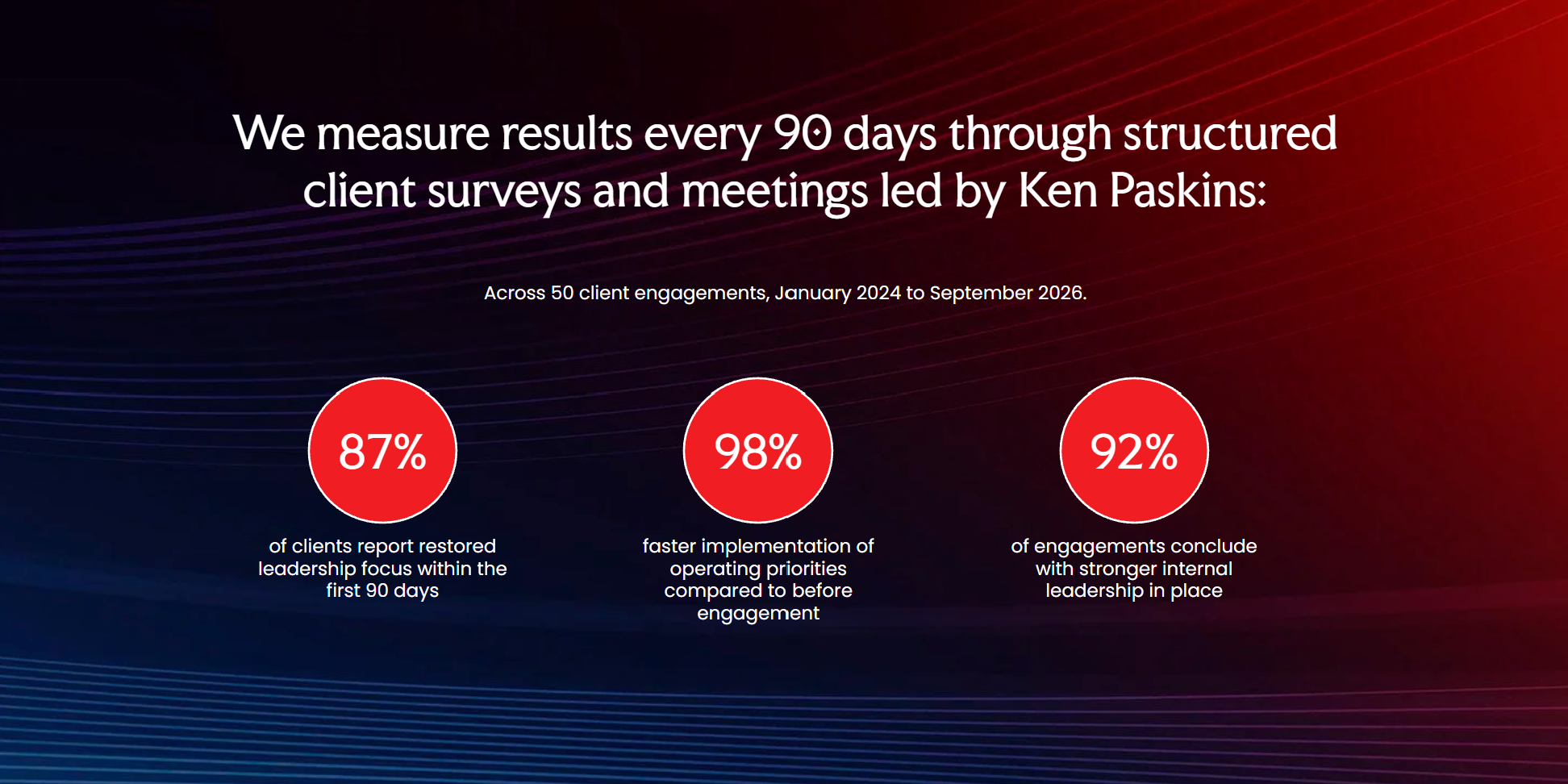
At GCE Strategic Consulting, we've measured 98% faster implementation of operating priorities across 50 client engagements between January 2024 and September 2026, compared with clients' performance before working with us. We track these results every 90 days through structured client surveys and review meetings.
Closing the execution gap in the next 90 days
Start with the next 90 days. Cut your quarterly priorities to a handful that will make a measurable difference to the business, and assign one leader to each with the authority to make decisions. Set up a weekly scorecard to track progress and use your leadership meetings to address missed commitments before they affect your targets.
At the end of the quarter, review what your team delivered against what it committed to achieve. Look at the impact on revenue, profit margins, or whichever business targets you set. If every decision still comes back to your desk, you have more work to do on accountability.
Get an experienced operator to own execution
GCE's fractional Integrators manage day-to-day operations and hold your leadership team accountable for delivering on the plan
Explore our Fractional Integrator (COO) Services