A customer complains about a delayed installation, but who is responsible for resolving it? Sales expects operations to handle the complaint, while operations assumes sales will follow up with the customer. The issue eventually reaches the founder, who has to step in and make the decision.
A responsibility matrix assigns one accountable leader to each business outcome, including hiring, pricing, payroll, and customer escalations.
In this article, we walk through the steps to create a responsibility matrix, with an example you can adapt to your leadership team.
What is a responsibility matrix?
A responsibility matrix is a table that maps business outcomes to the people or roles involved in delivering them. It identifies who is accountable for each result, who performs the work, who provides input, and who needs to stay informed.
The most common format is a RACI (Responsible, Accountable, Consulted, Informed) matrix, which defines four levels of involvement:
R – Responsible: The person or team performing the work needed to achieve the outcome.
A – Accountable: The leader who owns the final outcome and has the authority to make decisions.
C – Consulted: People whose expertise or input is needed before a decision is made.
I – Informed: People who need updates on progress or decisions but are not directly involved.
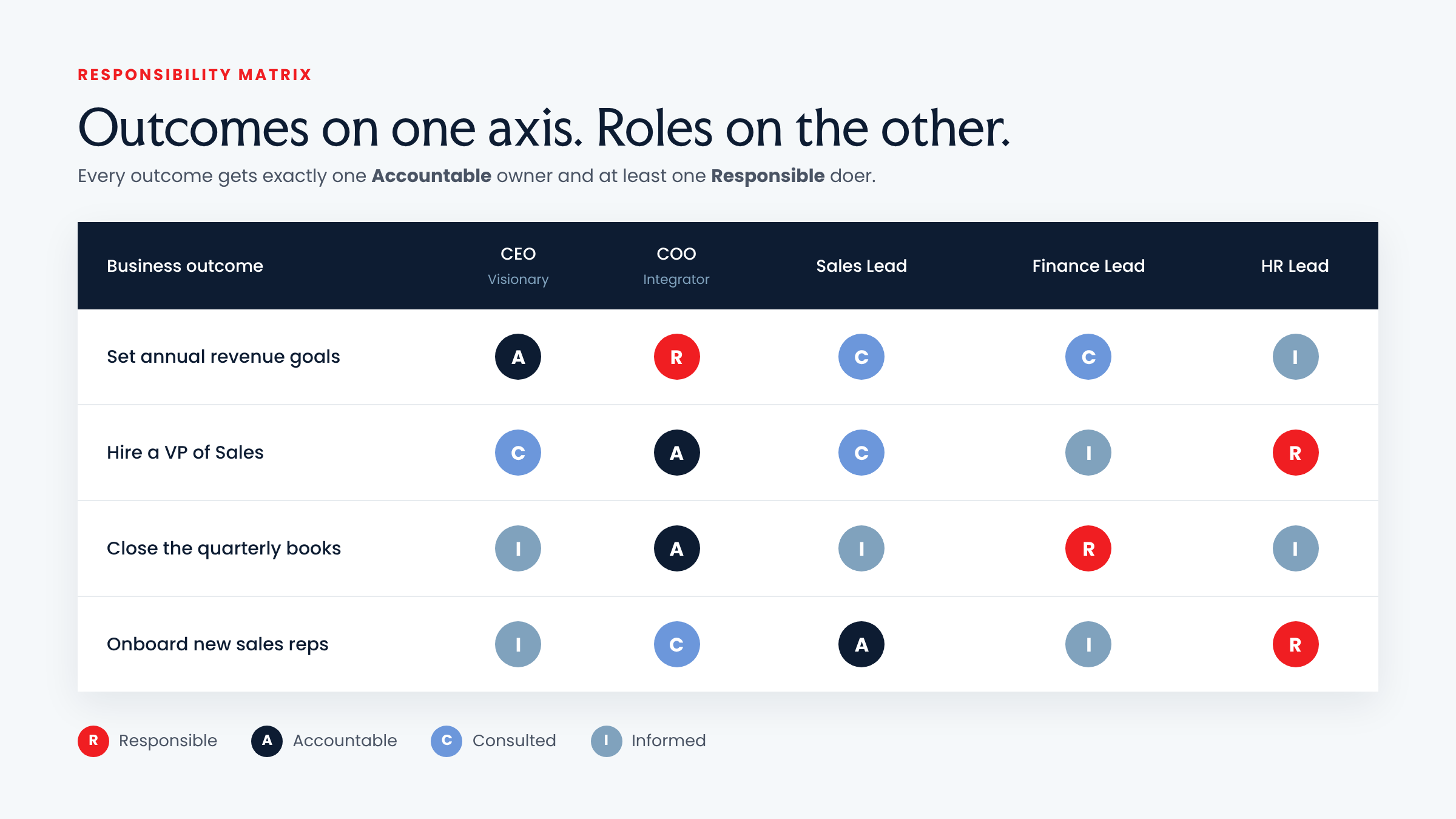
💡The golden rule is to assign exactly one Accountable person to each outcome. Several people can share the work, but one leader must ultimately answer for the result.
Why your org chart does not tell you who owns what
While an org chart shows who reports to whom and which departments each leader manages, it doesn’t necessarily establish who has final responsibility for outcomes that involve multiple departments.
Here's where an org chart can leave gaps in accountability:
| Where accountability breaks down | Example in your company |
|---|---|
| Dropped handoffs between departments | HR completes a new hire's paperwork, but finance never receives the payroll information. The employee's first paycheck is delayed. |
| Two leaders claiming ownership | Sales approves a customer discount, but finance rejects it after the quote has been sent. Neither leader knows who has final pricing authority. |
| No clear owner for an outcome | Finance prepares the month-end reports, but operations has not reconciled inventory records. Nobody takes responsibility for completing the close on time. |
| The founder as the default decision-maker | Department managers send routine hiring and spending approvals to the founder, even when the decisions fall within their approved budgets. |
| Responsibility without decision-making authority | The HR leader is responsible for employee benefits but cannot approve plan changes or costs, delaying the annual benefits renewal. |
Where accountability breaks down
Example in your company
Dropped handoffs between departments
HR completes a new hire's paperwork, but finance never receives the payroll information. The employee's first paycheck is delayed.
Two leaders claiming ownership
Sales approves a customer discount, but finance rejects it after the quote has been sent. Neither leader knows who has final pricing authority.
No clear owner for an outcome
Finance prepares the month-end reports, but operations has not reconciled inventory records. Nobody takes responsibility for completing the close on time.
The founder as the default decision-maker
Department managers send routine hiring and spending approvals to the founder, even when the decisions fall within their approved budgets.
Responsibility without decision-making authority
The HR leader is responsible for employee benefits but cannot approve plan changes or costs, delaying the annual benefits renewal.
With these accountability gaps in mind, let's look at the five steps to create a responsibility matrix.
How to make a responsibility matrix in 5 steps
A responsibility matrix works best when you map the outcomes your company needs to deliver, rather than individual tasks.
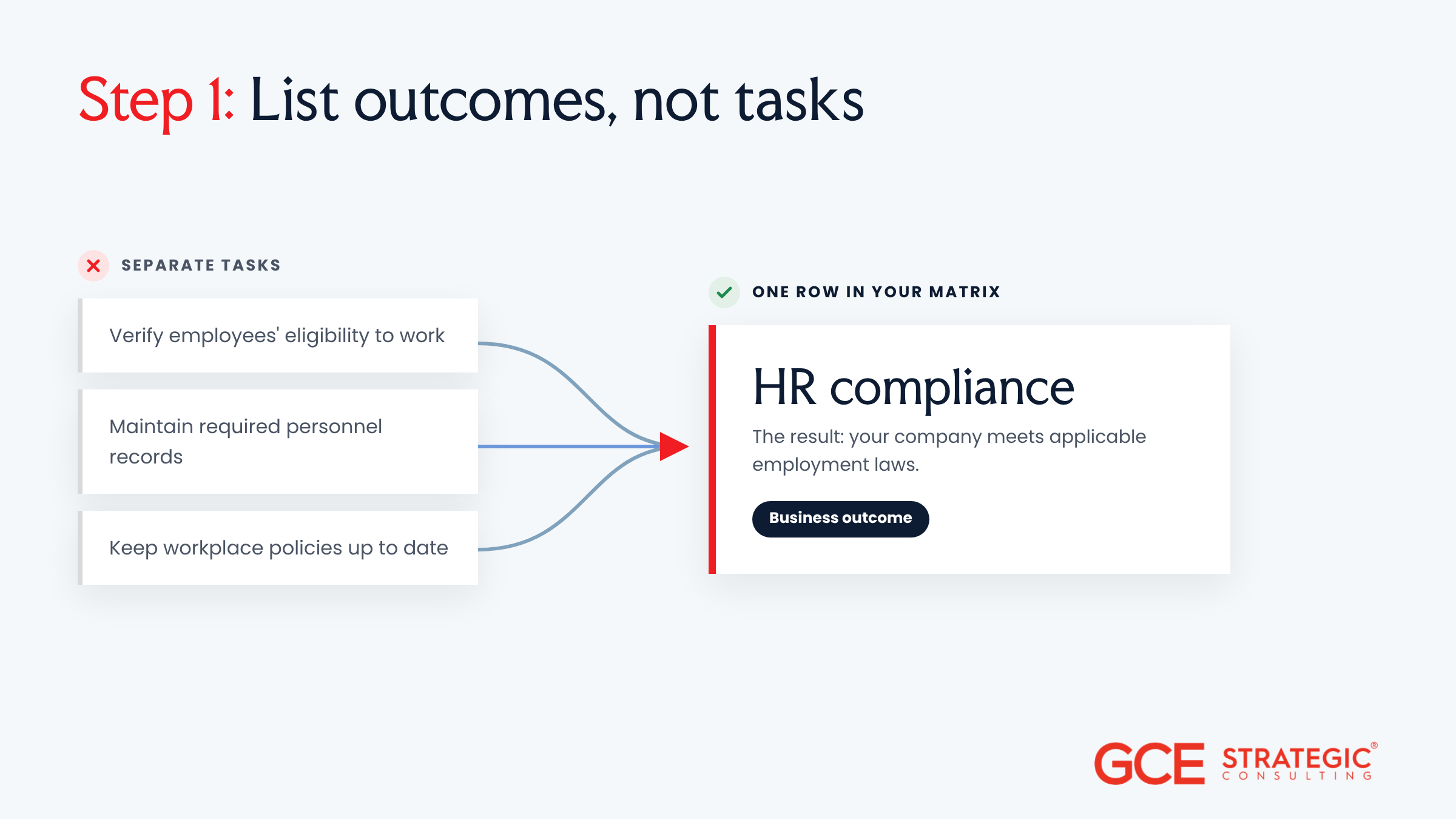
1. List outcomes, not tasks
Start by identifying the results you expect your company to achieve and the areas where someone needs to be held accountable. Each row in your responsibility matrix should represent a business outcome rather than an individual task.
For HR compliance, your company needs to meet applicable employment laws. That involves verifying employees' eligibility to work, maintaining required personnel records, and keeping workplace policies up to date. Instead of listing these activities separately, add HR compliance as one outcome in your responsibility matrix.
If you've outgrown your leadership structure, review the responsibilities your employees have taken on over time. Identify the outcomes your company needs before deciding which roles should own them.
2. List the roles that touch them
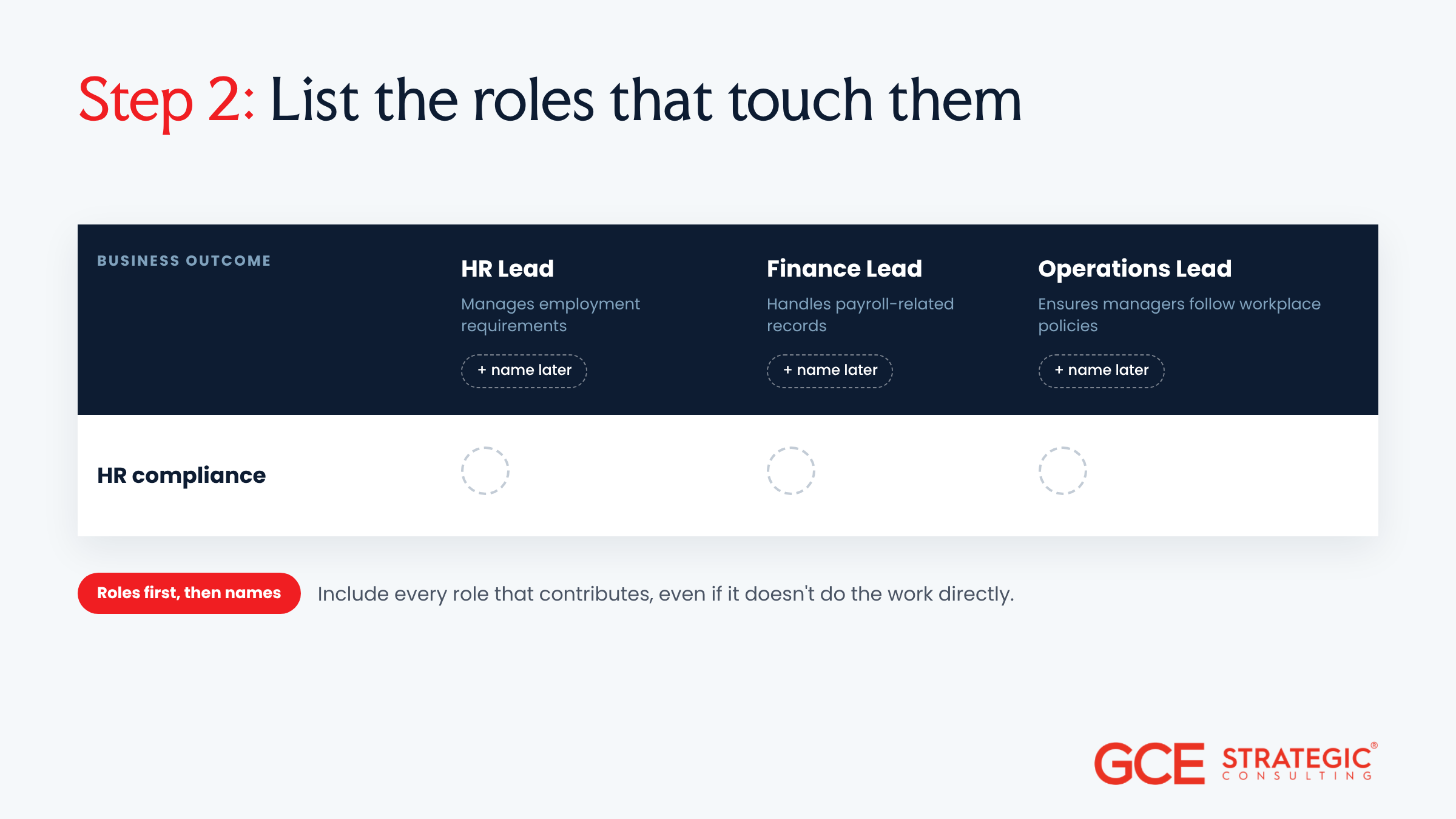
Once you've listed your business outcomes in the first column, add the roles involved in each outcome across the top of your matrix.
For example, HR compliance may involve your HR lead, finance lead, and operations lead. HR manages employment requirements, finance handles payroll-related records, and operations ensures managers follow workplace policies. Include every role that contributes to the outcome, even if the person in that role doesn't perform the work directly.
List roles first, then add names. Keep those roles separate in your matrix so you can see which responsibilities belong to each position, regardless of who currently fills it.
3. Give every row one owner
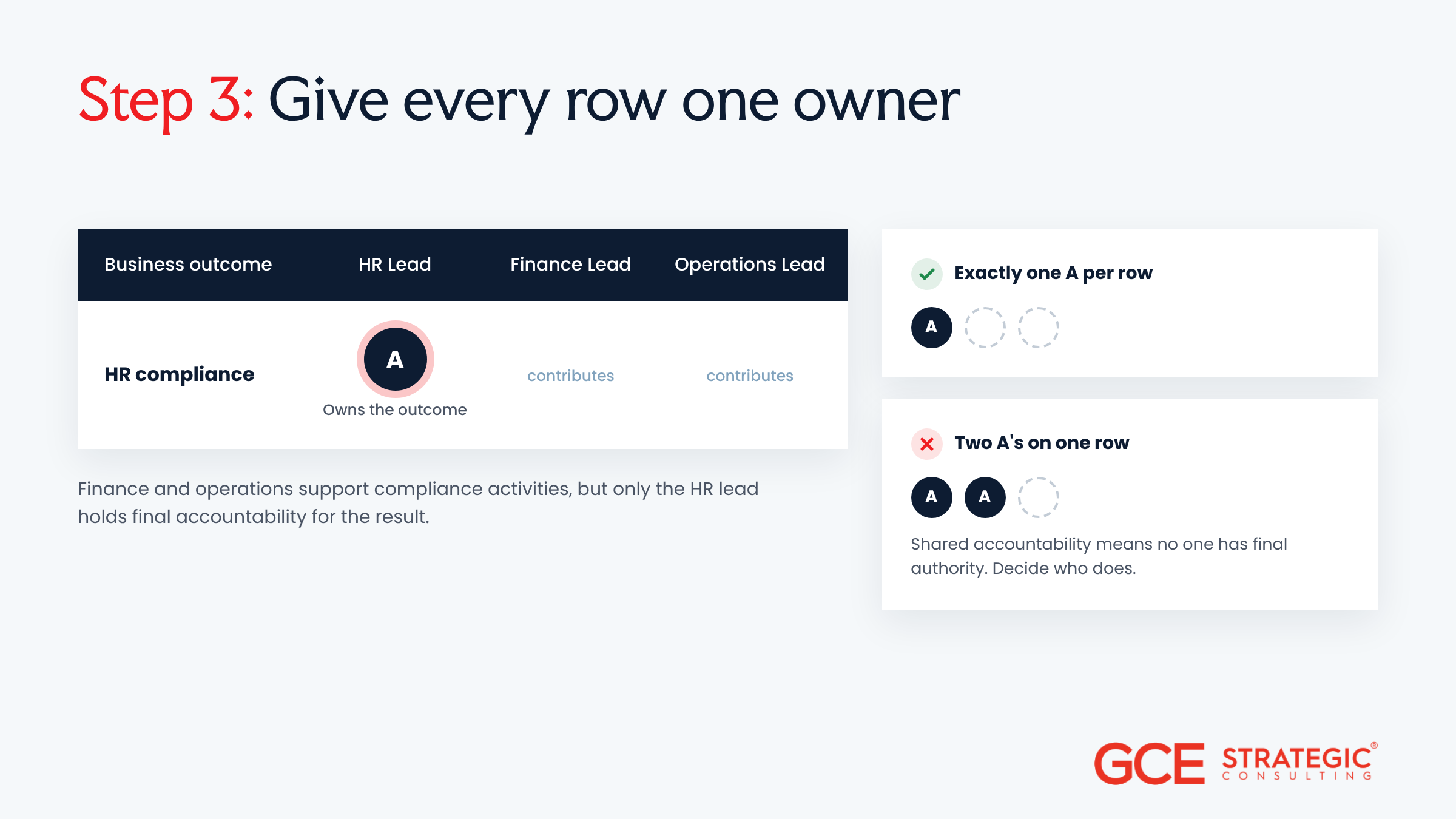
Now, decide which role has final accountability for each outcome and mark it with an A (Accountable) in your matrix. For HR compliance, your HR lead may be responsible for ensuring the company meets its employment law requirements. Your finance and operations leads may contribute to compliance-related activities, but the HR lead owns the overall outcome.
Assign exactly one A to each row. If two leaders share accountability, you need to establish who has final authority. If you're unsure where the founder's responsibilities end and operational leadership begins, review the differences between CEO vs COO responsibilities before assigning those roles in your matrix.
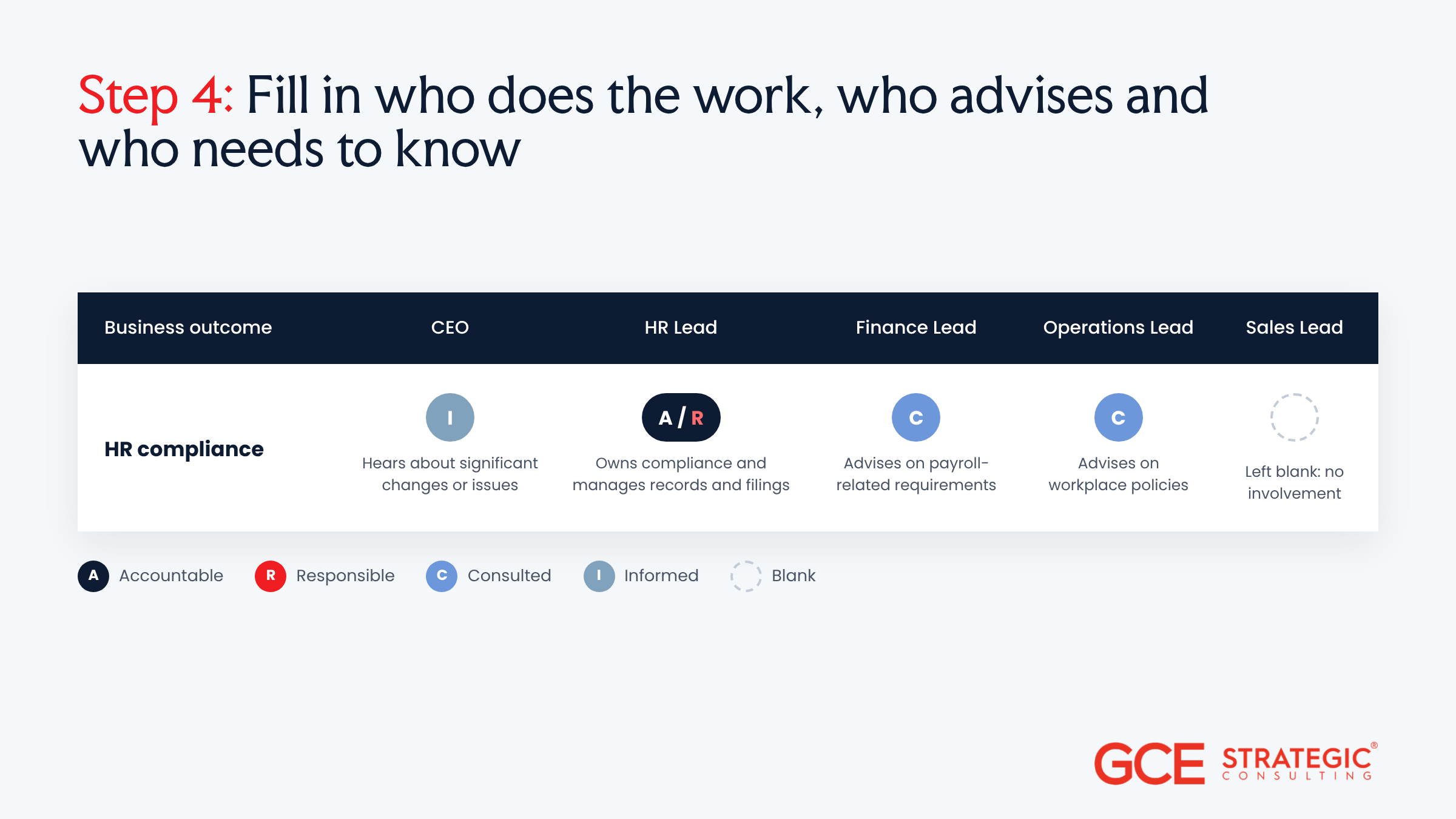
4. Fill in who does the work, who advises and who needs to know
Once you've assigned an accountable owner to each outcome, complete the remaining cells using the other three RACI letters: Responsible (R), Consulted (C), and Informed (I).
For your HR compliance row, you might assign both A and R to your HR lead if they oversee compliance and manage the required records and filings. Mark your finance lead as Consulted (C) for payroll-related requirements and your operations lead as Consulted (C) for workplace policies. Your CEO may only need to be Informed (I) about significant compliance changes or issues.
You can assign multiple roles as Responsible, Consulted, or Informed. You should leave cells blank when a role has no involvement.
5. Pressure-test the rows
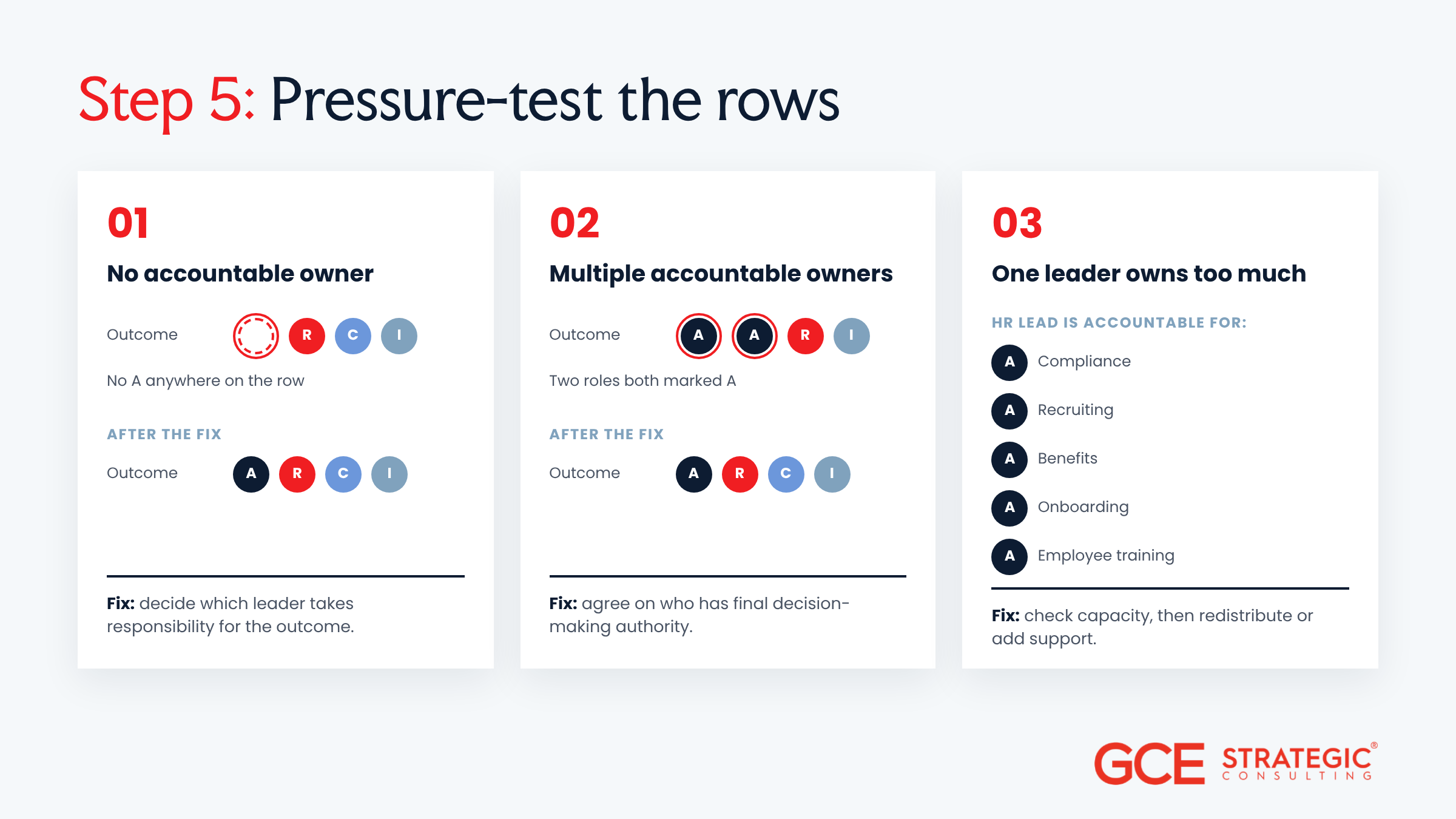
Before you finalize your responsibility matrix, review each row with your leadership team to check whether the ownership assignments will work in practice.
Look for three problems:
No accountable owner: If a row has no A, decide which leader should take responsibility for the outcome.
Multiple accountable owners: If two roles have an A, agree on who has final decision-making authority.
One leader owns too much: If the same person is accountable for most outcomes, review whether they have the capacity and authority to manage them all.
For example, if your HR lead owns compliance, recruiting, benefits, onboarding, and employee training, check whether they can realistically oversee all five outcomes. You may need to redistribute responsibilities or provide additional support.
Don't leave disagreements about ownership unresolved. Accountability breaks down before performance does when leaders accept unclear commitments and leave decisions hanging.
Responsibility matrix example you can copy
Use our free responsibility matrix template to assign ownership across your leadership team. It includes a completed example, a customizable RACI matrix, and an ownership review sheet that flags outcomes with missing or multiple accountable owners.
Download your free responsibility matrix template
Keeping it alive after the first draft
Review your matrix every quarter and whenever someone joins, leaves, or changes roles. Ask each leader whether they still have the authority and capacity to deliver the outcomes assigned to them. If one person owns too many outcomes or nobody has the experience to take responsibility for a particular area, you may need to redistribute responsibilities or strengthen your leadership team.
This also helps you build a culture of accountability, where everyone understands their responsibilities and is expected to follow through.
What changes when every outcome has an owner
When you're building your company, you may personally approve major expenses, resolve customer complaints, and make hiring decisions. But as your company grows, managing these decisions leaves your department leaders waiting for your approval instead of taking responsibility for their own areas.
A family-owned HVAC contractor faced a similar problem in its $30 million business unit, which employed 150 people. The leadership team struggled to resolve problems together, quarterly priorities were being missed, and responsibilities were poorly defined.
GCE brought in a fractional COO who assessed the company's operations, sales, and finance functions. The team revised leadership responsibilities, improved performance measures, introduced formal budgeting and management hiring processes, and provided twice-weekly coaching to sales leaders.
Within 120 days, the business unit recorded its highest billing quarter in 30 years, an 88% increase over the previous period. Completion of quarterly priorities also rose from 20% to 92%.
Let a Fractional COO Take Operations Off Your Plate
GCE's fractional COOs work inside your business to take ownership of day-to-day operations, develop your existing leaders, and help you delegate responsibilities with confidence.
Explore fractional COO support from GCE
Frequently asked questions
Is RACI outdated?
No, RACI helps define roles and responsibilities, but companies often make it more complicated than necessary. If you're using a responsibility matrix to manage business outcomes, focus on assigning one accountable owner to each outcome. You don't need to fill every Consulted (C) or Informed (I) cell unless those roles genuinely need to be involved.
What is the golden rule of RACI?
The golden rule of RACI is to assign exactly one Accountable (A) person to each outcome. Several people can perform the work or contribute to decisions, but only one person should have final accountability. Assigning two accountable owners creates confusion over who has the authority to make decisions and who must address problems when results fall short.