What is EOS®? A Complete Guide to the Entrepreneurial Operating System

EOS®, short for the Entrepreneurial Operating System®, is a practical business operating system that helps leadership teams clarify their vision, strengthen accountability, solve issues, and execute with more discipline.
That is the short version.
The better version is this: EOS® gives growing companies a common language and operating rhythm so the business does not depend on the founder holding everything together.
For founder-led companies, that matters.
Growth creates complexity. More people, more decisions, more priorities, more handoffs, and more opportunities. Without a clear operating system, the business starts drifting. Leaders work hard but pull in different directions. Meetings happen, but issues do not get solved. Goals are set, but execution gets inconsistent.
EOS® is designed to bring structure to that chaos.
It helps leadership teams answer the questions that determine whether the business can actually scale:
Where are we going?
Who owns what?
What numbers matter?
What issues need to be solved?
What processes must be followed?
What priorities must move this quarter?
EOS® is not theory. It is a simple, disciplined way to run the business.
What Is EOS®?
EOS® is a complete business management framework built around six key components: Vision, People, Data, Issues, Process, and Traction®.
The system helps entrepreneurial companies create clarity at the leadership level and turn that clarity into execution throughout the organization.
At its best, EOS® does three things:
It aligns the leadership team.
It creates accountability across the business.
It builds a cadence for solving issues and executing priorities.
EOS® is often used by founder-led companies, entrepreneurial leadership teams, and growing organizations that have outgrown informal management habits but do not want unnecessary corporate complexity.
The goal is not to make the company more complicated.
The goal is to make the business easier to run.
The Core Problem EOS® Solves
Most companies do not stall because the founder lacks vision.
They stall because the vision is not being translated into consistent execution.
The leadership team may not be aligned. Roles may be unclear. The company may be tracking too many numbers or the wrong numbers. Meetings may turn into updates instead of decisions. People may know there are issues, but no one is solving the root cause.
EOS® addresses that directly.
It gives the team a structure for getting on the same page, staying focused, measuring performance, and solving problems before they become permanent friction.
In plain terms, EOS® helps a business stop running on personality, memory, and urgency.
It helps the business run on clarity, rhythm, and ownership.
The EOS® Model: Six Key Components
EOS® is built around six components that strengthen how a company operates.
1. Vision
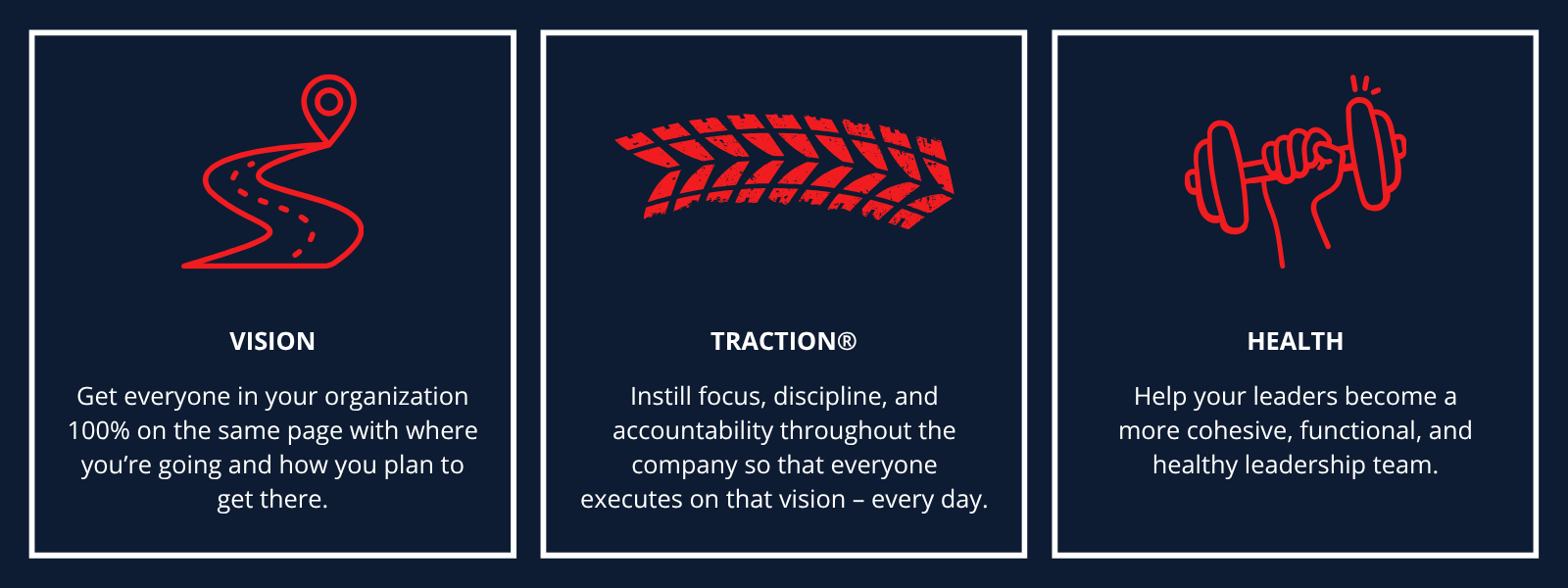
The Vision component gets the leadership team aligned around where the company is going and how it plans to get there.
This includes core values, core focus, long-term targets, marketing strategy, the 3-year picture, the 1-year plan, quarterly Rocks, and issues.
The main tool for this is the V/TO, or Vision/Traction Organizer®.
Vision only works when the team shares it, understands it, and uses it to make decisions.
2. People
The People component focuses on getting the right people in the right seats.
That means the business needs people who fit the company’s values and have the capacity, skill, and desire to own their roles.
This is where leadership teams have to be honest. A person can be loyal and still be in the wrong seat. A leader can be talented and still not be the right fit for the next stage.
EOS® gives teams a way to evaluate people and roles with more clarity.
3. Data
The Data component helps leadership teams run the business on facts instead of opinions.
This usually happens through an EOS scorecard, which tracks the weekly numbers that show whether the business is healthy.
The scorecard should not track everything.
It should track the few numbers that tell the truth early enough for leaders to act.
4. Issues
The Issues component gives the company a disciplined way to identify, discuss, and solve problems.
EOS® uses the IDS process: Identify, Discuss, Solve.
This matters because most teams are decent at naming issues and over-talking them. Fewer teams are disciplined about solving the real issue and assigning clear ownership.
A strong issues process prevents the same problems from showing up every week with different wording.
5. Process
The Process component helps the company define and follow the core processes that make the business work.
This may include sales, operations, hiring, onboarding, customer service, billing, and delivery.
The point is not to create a binder no one uses.
The point is to make the business repeatable so quality does not depend on one person remembering how something should be done.
6. Traction®
Traction® is where the plan turns into execution.
This includes quarterly priorities, commonly called Quarterly Rocks, weekly accountability, and disciplined follow-through.
Traction® is what keeps EOS® from becoming another planning exercise.
It forces the leadership team to decide what matters most in the next 90 days and who owns it.
How EOS® Works in Practice
EOS® works through a structured rhythm of planning, meetings, scorecards, Rocks, and issue-solving.
The system is simple by design.
The hard part is discipline.
The EOS® Meeting Rhythm
EOS® relies on a meeting pulse that keeps the business aligned.
The most familiar meeting is the weekly L10 meeting. This is where the leadership team reviews scorecard numbers, Rocks, customer and employee headlines, to-dos, and issues.
The purpose is not to sit in another meeting.
The purpose is to make decisions, solve issues, and create accountability.
EOS® also includes quarterly planning sessions and an annual planning session to keep the team connected to the larger vision.
Your First 90 Days on EOS®
The first 90 days on EOS® should create clarity, not perfection.
Most teams start by aligning around the vision, defining roles, building the scorecard, setting the first Rocks, and running consistent L10 meetings.
The goal is to build the rhythm.
Once the rhythm is in place, the team can improve the tools, sharpen the numbers, and strengthen accountability over time.
Who Is EOS® Right For?
EOS® is usually a strong fit for entrepreneurial companies that need more clarity, accountability, and execution discipline.
It is especially useful when:
The founder is still too involved in daily decisions.
The leadership team is not fully aligned.
Priorities keep shifting.
Meetings are not solving real issues.
Roles and ownership are unclear.
The business is growing, but operations feel chaotic.
EOS® is not only for large companies. It can work well for small and mid-sized businesses that are ready to operate with more structure.
The system is simple enough to understand and strong enough to expose where the business needs to mature.
What Do All These EOS® Terms Mean?
EOS® comes with its own language. These are the core terms business leaders need to understand.
Implementer
An Implementer helps teach and facilitate the EOS® process. They guide the leadership team through the tools and sessions.
Visionary
The Visionary is usually the founder or CEO. This person creates ideas, sees opportunity, drives relationships, and sets direction.
Integrator
The Integrator turns vision into execution. They lead the operating rhythm, align the leadership team, drive accountability, and make sure the business follows through.
Our integrator services support companies that need experienced operational leadership to help EOS® work inside the business.
V/TO
The Vision/Traction Organizer® is the tool that captures the company vision and turns it into a 1-year plan, quarterly Rocks, and issue list.
Accountability Chart
The Accountability Chart defines the structure of the business by seats, roles, and responsibilities.
It shows who owns what.
Scorecard
The Scorecard tracks weekly numbers that show whether the business is on track.
Rocks
Rocks are quarterly priorities. They create 90-day focus and prevent the team from trying to move everything at once.
L10 Meeting
The L10 is the weekly leadership meeting used to review numbers, Rocks, to-dos, and issues.
IDS
IDS stands for Identify, Discuss, Solve. It is the EOS® process for solving issues at the root.
EOS® vs. Other Management Frameworks
EOS® is different from many business frameworks because it is built for practical execution.
Some frameworks focus heavily on strategy. Others focus on process improvement, performance management, or leadership development.
EOS® connects those pieces into one operating system.
It gives teams a way to define the vision, assign ownership, track numbers, run meetings, solve issues, and execute priorities.
That simplicity is part of its strength.
How EOS® Benefits Business Leaders
EOS® helps business leaders create more clarity, better accountability, and stronger execution.
For founders and CEOs, the biggest benefit is often relief.
Not because EOS® makes the business easy.
Because it makes the business more visible.
Leaders can see what matters, who owns it, what is off track, and what needs to be solved.
That gives the CEO a better way to lead without staying buried in every detail.
Implementing EOS® in Your Business
Implementing EOS® works best when leadership treats it as an operating discipline, not a one-time project.
Step 1: Align Your Leadership Team
The leadership team has to agree on the direction, the issues, and the need for change.
Without alignment at the top, EOS® will not cascade through the business.
Step 2: Build Your Vision/Traction Organizer
The V/TO gives the team one shared view of the company’s direction and priorities.
Step 3: Launch Your First L10 Meeting
The weekly L10 creates the operating rhythm for accountability and issue-solving.
Step 4: Set Your First Quarterly Rocks
Quarterly Rocks turn the annual plan into 90-day execution.
Step 5: Establish Your Annual Planning Rhythm
EOS® annual planning keeps the team connected to the larger vision while quarterly planning keeps execution focused.
Common Challenges in Implementing EOS® and How to Overcome Them
The biggest challenge is not understanding EOS®.
It is living it.
Common challenges include setting too many Rocks, tolerating vague ownership, skipping scorecard discipline, avoiding hard people decisions, and letting L10 meetings become status updates.
The fix is operating discipline.
Keep the priorities narrow. Assign real owners. Review the numbers weekly. Solve issues at the root. Use the tools consistently.
EOS® works when leaders stop treating it like an idea and start running the business through it.
Work With a GCE EOS® Expert
EOS® can give your business the structure to gain clarity, strengthen accountability, and execute with more discipline.
But tools alone do not run a company.
People do.
We help founder-led companies get more from EOS® by providing experienced Integrator and operational leadership support inside the business. We help teams clarify ownership, strengthen cadence, improve scorecards, and turn vision into execution.
If your company has the EOS® tools but still lacks traction, the issue may not be the system.
It may be that no one is truly driving it.
FAQ About EOS® — Entrepreneurial Operating System
What is the difference between EOS® and other business frameworks?
EOS® is designed as a complete operating system for entrepreneurial companies. It connects vision, people, data, issues, process, and traction into one practical framework for running the business.
How long does it take to implement EOS®?
Most teams can begin using the core EOS® tools within the first 90 days, but full adoption takes consistency over time. The system becomes stronger as the leadership team uses the tools weekly, quarterly, and annually.
Do you need a Professional EOS® Implementer®?
Some companies use a Professional EOS® Implementer® to teach and facilitate the system. Others also need an Integrator or operating leader to help drive execution inside the business after the sessions end.
What size company is EOS® designed for?
EOS® is often used by small and mid-sized entrepreneurial companies that need more structure, accountability, and execution discipline as they grow.
Entrepreneurial Operating System®, EOS®, Vision/Traction Organizer®, Traction®, L10®, and related trademarks are owned by EOS® Worldwide, LLC. GCE Strategic Consulting is not endorsed by or affiliated with EOS® Worldwide, LLC.