Delegate and Elevate: The EOS® Tool That Frees Founders From the Bottleneck

TL;DR
Delegate and Elevate helps leaders sort responsibilities into four quadrants based on how much they enjoy the work and how well they do it. EOS recommends keeping at least 80% of boss-related activities in Love/Great and Like/Good, then delegating work from the bottom two quadrants.
The next step is assigning that work to the right owner. Operational work may move to an Integrator, functional work to department leaders, and tactical execution to the team. Each handoff should clarify ownership, training, timing, success measures, and whether the receiver GWC™ the role.
A founder’s time is often split between two very different kinds of work. One part goes to setting direction, building key relationships, and making high-impact decisions. The other goes to approvals, hiring questions, operational reviews, team issues, and recurring decisions that someone else may be ready to own.
Delegate and Elevate helps leaders sort that work into four quadrants based on two things: how much they enjoy it and how well they do it. EOS® recommends that at least 80% of boss-related activities sit in the top two quadrants.
In this article, we explain the four quadrants, the 80% rule, and how to make those handoffs clearly.
What is Delegate and Elevate?
Delegate and Elevate is an EOS® tool that helps leaders review how they spend their time and redistribute responsibilities across the team.
You list the significant activities you manage, from strategic planning and customer relationships to hiring, project management, reporting, and approvals. You list the significant activities you handle, then sort each one based on how much you enjoy the work and how well you do it.
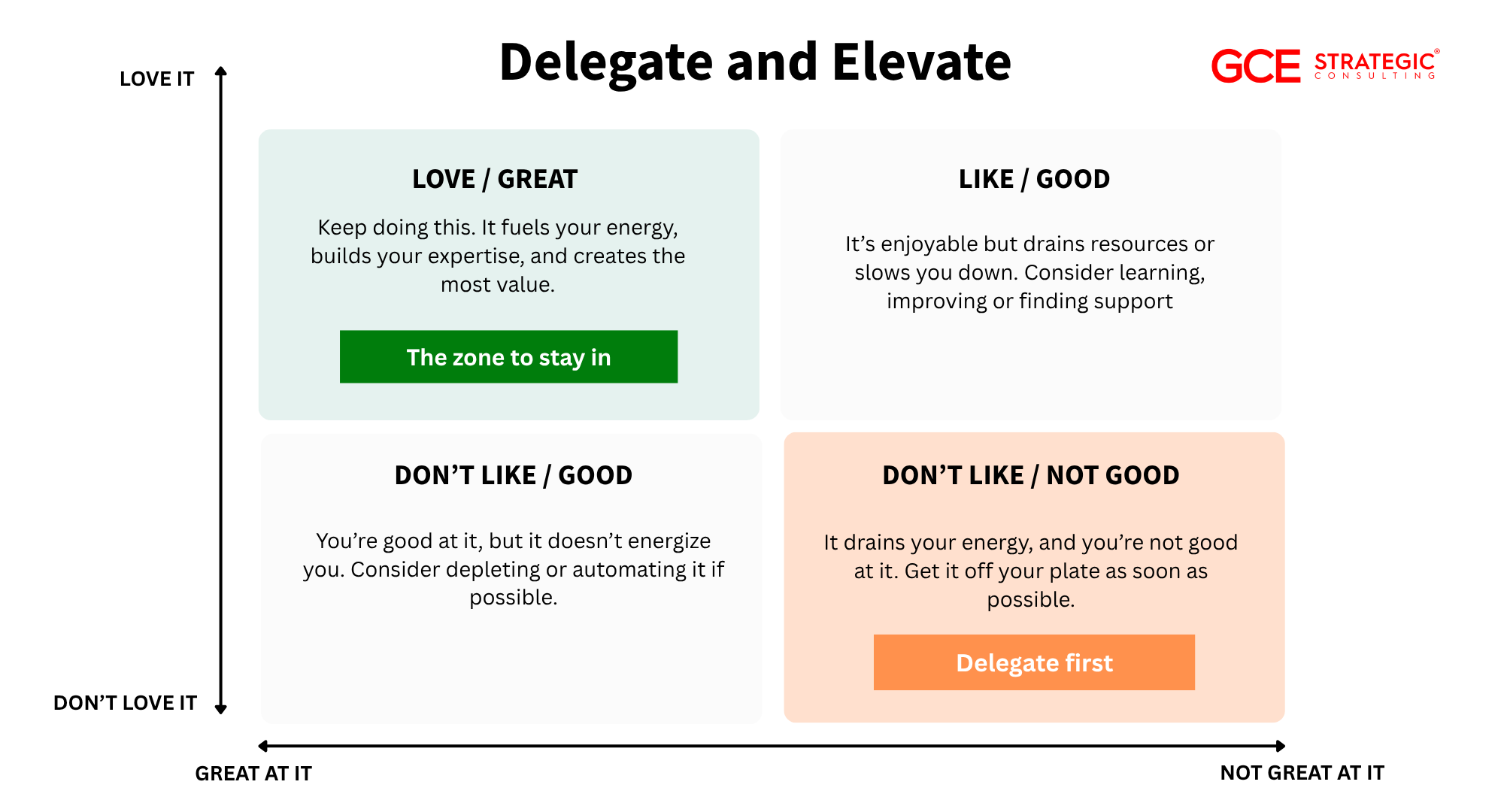
The tool uses four quadrants:
Love it / Great at it: Work you enjoy and perform exceptionally well
Like it / Good at it: Work you enjoy and do well
Don’t like it / Good at it: Work you can do well but would benefit from delegating
Don’t like it / Not good at it: Work you should prioritize for delegation
EOS recommends that at least 80% of your boss-related activities fall into the top two quadrants. So what belongs in each quadrant, and what should you do with the work once it’s there?
💡Delegate and Elevate is an EOS Worldwide tool. EOS® is a registered trademark of EOS Worldwide, LLC. GCE Strategic Consulting is not affiliated with EOS Worldwide.
The four quadrants (and the one that traps most founders)
The four quadrants help you decide which responsibilities should stay with you and which should move to another owner. Don’t Like/Good quadrant deserves close attention because it includes work you perform well but no longer need to own. Your competence can keep that work routed back to you long after someone else could take responsibility for it.
Love/Great
Love/Great covers the work you genuinely enjoy and perform exceptionally well. EOS refers to this as your Unique Ability. These are the activities that give you energy and let you make your highest contribution to the business.
That could mean setting company direction, building strategic partnerships, selling to high-value prospects, developing new offers, or solving a particular kind of business problem. The activity belongs in Love/Great only when both things are true. You want to spend time on it, and your results justify keeping it with you.
Like/Good
Like/Good covers work you enjoy and do well. EOS includes this quadrant in the 80% target alongside Love/Great, so these responsibilities can stay with you.
This could include interviewing candidates, mentoring managers, reviewing performance reports, or joining selected customer calls. The exact activity will differ by leader. What matters is that you like doing it and consistently produce good results.
However, you should keep an eye on how much of your schedule this quadrant takes up. EOS notes that spending too much time there can limit the time available for your highest-value contribution.
Don’t Like/Good
Don’t Like/Good covers work you have learned to do well, often through repetition or necessity, but no longer enjoy doing. EOS recommends delegating these responsibilities so you can spend more time in the top two quadrants.
This is where competence can work against you. If you’re good at reviewing project plans, resolving client escalations, checking financial reports, or approving proposals, people will keep bringing that work to you. Being capable of doing it doesn’t mean you should be the owner.
Don’t Like/Not Good
Don’t Like/Not Good covers work you neither enjoy nor perform particularly well. These responsibilities are usually the clearest candidates for delegation because they take time away from work where you contribute more value.
Examples might include detailed financial reporting, project administration, contract review, scheduling, or managing a function outside your area of expertise. The activity itself is not unimportant, but it simply needs a better owner.

Ready to elevate your team? We have an exclusive offer for you.
Take your organization to the next level with our free 14-week coaching program—for up to 5 managers. This limited-time offer will empower your mid-level leaders to become EOS® champions who boost engagement and execution. Partner with GCE Strategic Consulting and start gaining real traction today.
How to map your activities
Start by mapping the work you do, not the work your job description says you do.
Capture a full work cycle: Write down the significant activities you manage across a typical day, week, and month. Include recurring work such as leadership meetings, one-on-ones, hiring interviews, proposal reviews, financial reviews, customer calls, and vendor decisions.
Keep the list at the activity level: Avoid broad labels such as ‘management’ or ‘operations.’ Instead use ‘review monthly financials,’ ‘approve client proposals,’ or ‘run weekly one-on-ones’. This also makes it easier to spot operational debt, where responsibilities have accumulated without clear ownership.
Sort each activity honestly: For every item, decide how much you enjoy doing it and how well you perform it. Then place it in Love/Great, Like/Good, Don’t Like/Good, or Don’t Like/Not Good. Rank your fit with the work rather than how important the activity is to the company.
Calculate your 80%: Estimate how much of your boss-related time goes to Love/Great and Like/Good. Add those hours together, divide them by your total boss-related hours, then multiply by 100. For example, if 24 out of 30 hours sit in the top two quadrants, you’re at 80%. The remaining six hours show you where to look for work that could move elsewhere. If too much of your week goes to work that belongs elsewhere, the result can contribute to leadership burnout and leave less time for strategic work
Identify who could own the work next: Start with Don’t Like/Not Good, then review Don’t Like/Good. Some responsibilities may already have a clear owner. Others may expose a gap in your leadership team that you need to address before the work can move.
The real question: who takes the delegated work?
Once you know which tasks should move off your list, decide where each responsibility belongs. The answer depends on whether the work is operational, functional, or tactical.
Day-to-day operations → an Integrator
Recurring operational decisions, cross-functional priorities, leadership-team accountability, and issue resolution typically belong with an Integrator. The Integrator turns the Visionary’s direction into execution and keeps day-to-day operations moving. A Visionary and Integrator split also helps prevent both leaders from owning the same decisions.
For example, you may set the company’s annual growth priorities while the Integrator owns the weekly follow-through across Sales, Operations, Finance, and the rest of the leadership team.
Functional work → functional or interim leaders
Finance, Sales, HR, recruiting, and other specialist responsibilities should move to the leader accountable for that function. A CFO can own financial reporting and forecasting. A Head of Sales can own pipeline reviews and sales-team performance. An HR leader can own hiring processes and people operations.
If that leader is not in place yet, you may need to build, borrow, or buy talent depending on whether you can train someone internally, need short-term leadership support, or are ready to make a permanent hire.
Tactical execution → the team
Tasks such as preparing reports, scheduling meetings, updating project trackers, following documented processes, or completing routine customer onboarding should sit with the people closest to the work.
The handoff needs to include more than the task itself. Be clear about the expected outcome, what decisions the person can make independently, and when an issue should come back to leadership. That gives the team room to execute without turning every delegated task into another approval request.

Delegate without dumping: the handoff playbook
Delegating transfers ownership with clarity. Dumping throws work over the wall and hopes someone figures it out. EOS makes the distinction explicitly and recommends planning the handoff before the work moves.
Use four questions to structure the handoff:
Who owns it? Name one person who becomes accountable for the responsibility. Be clear about which decisions they can make without coming back to you.
What training do they need? Identify the knowledge, process, or context they need before taking ownership. That could mean documenting a workflow, reviewing past decisions, or working through the process together first.
When does the handoff happen? Set a clear point when ownership moves. Everyone involved should know when the new owner starts making the decisions and completing the work independently.
How will you measure success? Agree on what good performance looks like. Depending on the responsibility, that could be a deadline, quality standard, KPI, or Scorecard measure.
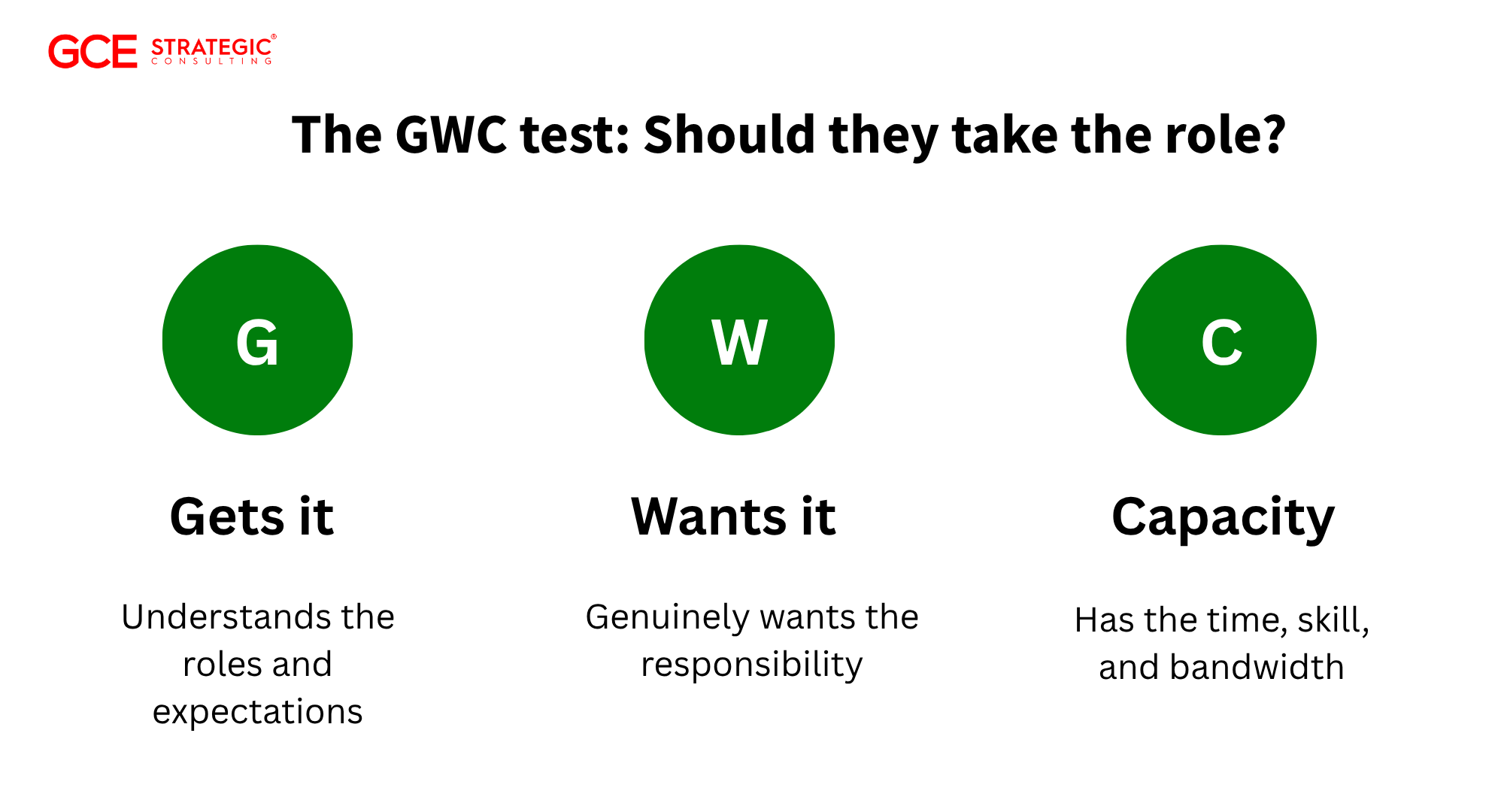
Before you hand over the work, apply one more test. The person receiving it should GWC™ the role.
In EOS, that means they Get it, Want it, and have the Capacity to do it.
“Get it” means they understand the role and its expectations.
“Want it” means they genuinely want the work.
“Capacity” means they have the time, skills, knowledge, and ability to perform it well. EOS requires a yes on all three.
Your next 90 days: Make delegation a habit
Use your next quarterly cycle to move a small set of responsibilities from Don’t Like/Good and Don’t Like/Not Good to new owners. For each one, name the owner, define what they can decide, provide the training they need, and agree on how you’ll measure success. If the work keeps coming back to you, fix the handoff before moving more.
For companies ready to give the leadership team more ownership of day-to-day operations, GCE’s Fractional Integrator Services can provide experienced operational leadership. A Fractional Integrator can take ownership of daily execution and strengthen accountability across the team.
With GCE, founders have more time to focus on vision, strategic relationships, and growth.
Give your leadership team room to lead
GCE Fractional Integrators can lead day-to-day execution, clarify accountability, and help your team take on more operational responsibility. Start a conversation